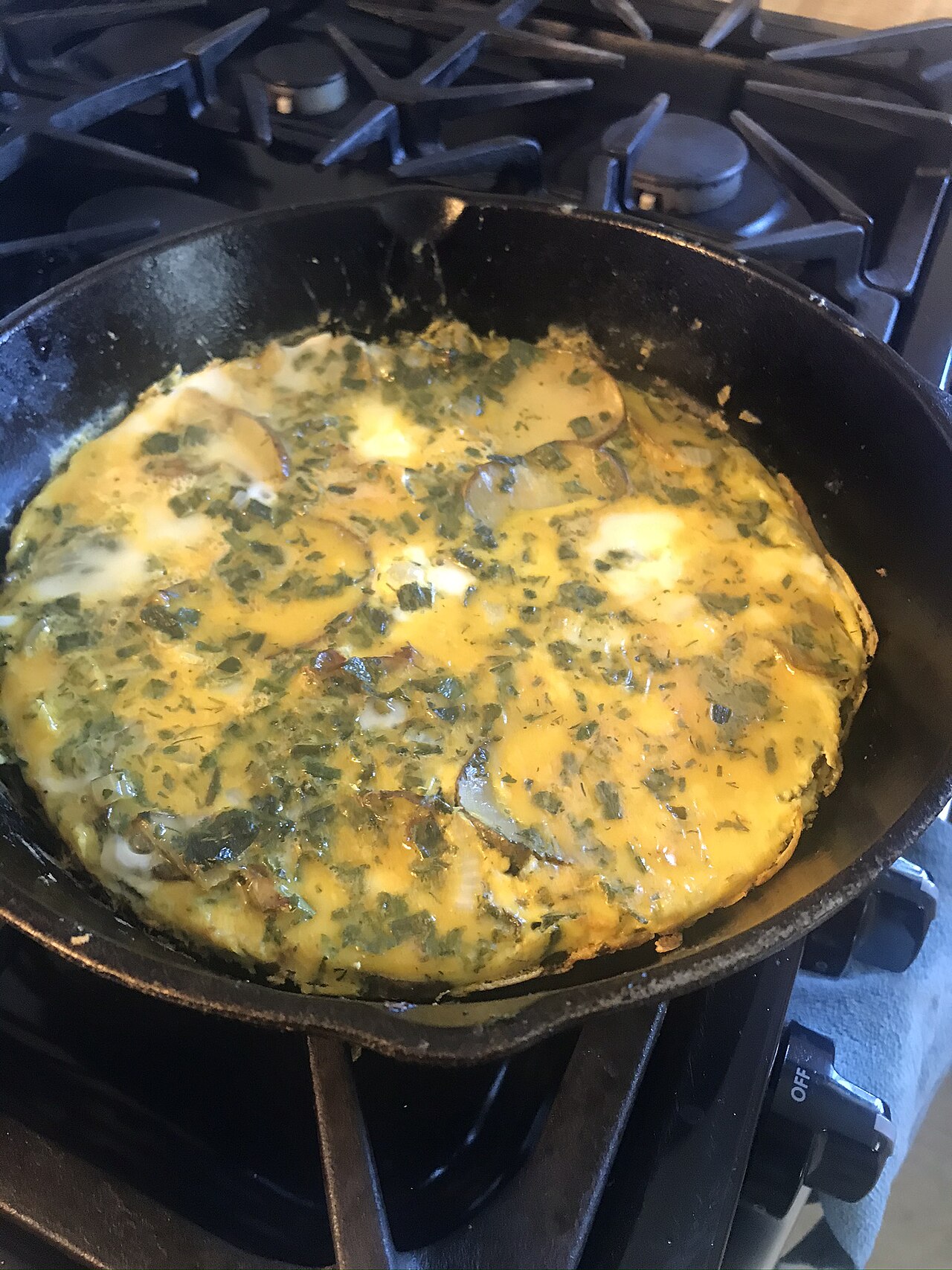
The potatoes are softened gently in oil before meeting the eggs, and much of that oil is drained away. This home version includes onion and a fully set center, making its choices clear without claiming that every Spanish household cooks tortilla identically.
Spanish Potato Tortilla
Plus 5 minutes mixture resting and 10 minutes final resting
Planning totals add preparation, cooking and listed waits. Overlapping stages may shorten the schedule; ingredient and equipment differences can lengthen it.
Ingredients
For fractional eggs, beat an extra egg or yolk and measure the required fraction.
Times and base yield refer to the original recipe. Scaling quantities does not automatically change pan size, temperature or cooking time.
Step-by-step method
The steps describe the base batch (4 servings). The calculator changes the ingredient list only; amounts written in the steps, equipment and timing remain for that base batch.
Step 1
Cook potatoes and onion gently in olive oil for 20–25 minutes until tender without crisp browning.
Step 2
Drain in a sieve set over a heatproof bowl, reserving the oil for another cooking use.
Step 3
Beat eggs with salt and fold in warm potatoes and onion, resting for 5 minutes.
Step 4
Heat two tablespoons of the reserved oil in a non-stick 22 cm skillet and add the mixture.
Step 5
Cook over low heat until the base sets, then invert carefully onto a plate and slide back into the pan.
Step 6
Cook until the center is fully set for this version, then rest for 10 minutes before slicing.
Why this version works
Slice potatoes for tenderness rather than crispness
Cut the 700 grams of potatoes into thin even slices, roughly two to three millimeters where practical. Irregular shapes are acceptable, but thick chunks take longer and can remain firm beneath cooked egg. The oil should bubble gently around them, not fry them into brown chips. Stir carefully so pieces cook evenly without being mashed completely. Onion slices can soften alongside the potato, adding sweetness and moisture. Choose a potato that becomes tender without immediately disintegrating. A few broken edges help bind the mixture, but an entire pan of potato puree loses the intended layered texture.
Drain oil while keeping the warm potato useful
Set a sieve over a heatproof bowl before lifting the potatoes, since hot oil should never be poured into a fragile cold glass container. Let excess oil drain rather than squeezing the slices dry. The 200 milliliters listed are a cooking medium, not the amount intended to remain in the finished tortilla. Reserve clean drained oil for another suitable savory use after cooling and handling it appropriately. Fold warm, not fiercely hot, potatoes into beaten eggs. A short rest lets egg flow around the slices and makes the mixture easier to distribute evenly in the skillet.
Use the pan diameter to control thickness
A 22-centimeter non-stick skillet creates a substantial tortilla from six eggs and the cooked potatoes. A wider skillet produces a thinner round that sets faster; a smaller one needs more patient heat to reach the center. Warm a little reserved oil, pour in the mixture and level it gently. Low to medium-low heat is more useful than a dark crust formed in seconds. As the edge sets, loosen it with a flexible spatula. The goal is enough structure for turning while the center remains coherent, not a browned exterior surrounding a completely loose liquid middle.
Make the turn a planned operation
Choose a plate wider than the skillet before cooking begins. Remove the pan from active heat, hold the plate firmly over it with protected hands and turn in one controlled movement. Slide the tortilla back into the pan without dragging a torn edge beneath it. If a whole-pan inversion feels awkward, use a smaller batch rather than forcing an unwieldy heavy skillet. This recipe finishes the center fully; a soft or runny traditional preference should not be assumed suitable for every diner. Rest before slicing so potato and egg hold together and the first wedge does not collapse.
Keep the reserved oil separate from the cooked mixture
Drain the potatoes over a heatproof bowl, then measure the small frying portion from that reserved oil. The full oil allowance is a cooking medium and should not all return with the potatoes to the beaten eggs. Let the slices cool from aggressively hot to comfortably warm before combining, and fold rather than crushing them. Choose a turning plate before the first side sets. If the skillet is heavy or awkward, a smaller properly portioned tortilla is a practical adaptation, but it changes depth and needs its own center check.
Ingredient choices and substitutions
Use potatoes that become tender without disintegrating and a pan with a reliable non-stick surface. Olive oil is part of the cooking medium; much of it is drained rather than eaten in the finished tortilla.
Fixes for this recipe
| What you notice | Likely reason | What to do |
|---|---|---|
| The outside is dark while the center is liquid. | The heat is too strong for the tortilla's thickness. | Lower the heat and continue gently, covering briefly if needed. Next time use the specified pan size or make a thinner tortilla rather than increasing the burner. |
| Potato slices remain hard in the finished wedge. | They did not become tender during the oil-cooking stage. | Cook the potato fully before adding egg in the next batch. Egg setting time cannot reliably replace the separate potato-softening stage. |
| The tortilla splits during turning. | The first side lacked structure, the pan stuck or the plate was too small. | Use a reliable non-stick pan, loosen the edge and wait for a coherent base. Choose a larger plate and make a smaller round if handling is difficult. |
Recipe-specific questions
Does the tortilla absorb all the listed oil?
No. The potatoes cook in a generous oil bath and are then drained, with only a small measured amount reused in the skillet. Do not pour the entire drained bowl into the eggs.
Can I omit onion?
Yes. It changes sweetness and moisture, so the result is a deliberate onion-free variation. Keep potato tenderness and gentle egg cooking as the central controls rather than replacing onion with another wet vegetable automatically.
Can I finish it under a grill instead of flipping?
Only if the skillet and handle are explicitly grill-safe. This changes how the upper surface sets and may give more top color. A smaller flipped tortilla is often simpler than adapting unsuitable cookware.
Serving and storage
Tomatoes with olive oil and a little vinegar provide a fresh contrast. Bread is optional because the tortilla already contains substantial potato; a crisp pepper salad can make the plate more varied.
Refrigerate cooled wedges promptly in a covered container. For serving cool, keep them chilled until reasonably close to the meal rather than leaving cooked egg on a warm counter for hours. Reheat gently until thoroughly hot if desired, accepting that the egg becomes firmer.
An AI-assisted editorial guide, not independently kitchen-tested. The photograph is a serving example. How we prepare and correct our guides.
For safe handling, consult FDA guidance. Send recipe corrections by email to ZYS10.